Machine Learning-based Ground Motion Prediction Models for Indonesia: A Performance Evaluation of XGBoost and Random Forest Against Conventional GMPE
DOI:
https://doi.org/10.31172/jmg.v27i1.1233Keywords:
Ground Motion Prediction Equation (GMPE), Machine Learning Seismology, Peak Ground Acceleration (PGA), Seismic Hazard Assessment, IndonesiaAbstract
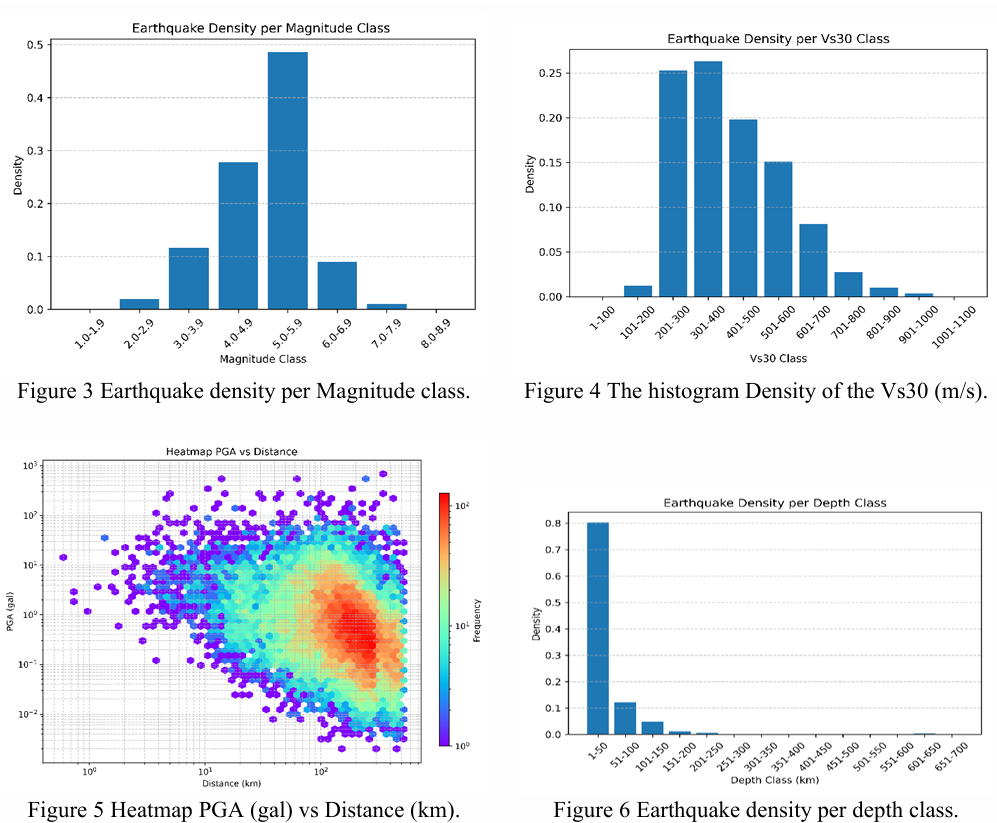
Accurate ground motion prediction is critical for seismic hazard mitigation in Indonesia, a region characterized by complex tectonic settings. Conventional Ground Motion Prediction Equations (GMPEs) often struggle to capture the non-linear attenuation characteristics of local seismicity. This study develops national-scale Machine Learning (ML) models—specifically XGBoost and Random Forest (RF)—to predict Peak Ground Acceleration (PGA) and benchmarks them against the widely used Zhao et al. [23] model. The dataset comprises 20,287 strong-motion records from 1,573 events (M 1.6–7.9) recorded by 667 stations across Indonesia between January 2023 and April 2025. Performance evaluation reveals that the XGBoost model outperforms both RF and the conventional GMPE, achieving the lowest Mean Squared Error (MSE) of 0.8885. In contrast, the conventional model showed less reliability with a significantly higher MSE of 1.5905. Feature importance analysis indicates that hypocentral distance and magnitude are the dominant predictors, while site condition (Vs30) plays a secondary role. Validation on independent test sets and recent significant seismic events confirms the model's robust generalization capability compared to conventional approaches. These findings demonstrate that ML-based approaches provide a more reliable alternative for estimating ground motion in Indonesia, offering significant potential for improving early warning systems and hazard maps.
Downloads
References
A. C. Windiyanti, karyanto, Rustadi, and Rudianto, “Analisis Zona Rawan Gempabumi Daerah Lampung Berdasarkan Nilai Percepatan Tanah Maksimum (Pga) Dan Data Accelererograph Tahun 2008-2017,” JGE (Jurnal Geofisika Eksplorasi) , vol. 3, no. 2, pp. 17–27, 2019.
S. H. Pandadaran, G. F. A. Muabuay, S. E. Kurniawan, and M. Fadhilah, “Ground motion prediction equation for West Sumatra due to distant shallow crustal, interface, andiIntraslab warthquakes,” in E3S Web of Conferences, 2020. doi: 10.1051/e3sconf/202015603001.
R. I. Hielmy, “Perbandingan Metode Davenport, Milne, dan McGuirre dalam Penentuan Nilai Percepatan Tanah Maksimum di Pulau Bali,” Buletin Meteorologi, Klimatologi, dan Geofisika, vol. 5, no. 5, pp. 9–16, 2024.
R. I. Hielmy and M. L. Rajagukguk, “Analisis probabilistik bahaya seismik di denpasar dan sekitarnya berdasarkan pendekatan psha,” Jurnal Online Physics, vol. 11, no. 1, pp. 21–28, 2025.
M. Ryo and M. C. Rillig, “Statistically reinforced machine learning for nonlinear patterns and variable interactions,” Ecosphere, vol. 8, no. 11, pp. 1–16, 2017, doi: 10.1002/ecs2.1976.
A. Mohammadi, S. Karimzadeh, S. A. Banimahd, V. Ozsarac, and P. B. Lourenço, “The potential of region-specific machine-learning-based ground motion models: Application to Turkey,” Soil Dynamics and Earthquake Engineering, vol. 172, p. 108008, 2023, doi: 10.1016/j.soildyn.2023.108008.
H. Kubo, T. Kunugi, W. Suzuki, S. Suzuki, and S. Aoi, “Hybrid predictor for ground-motion intensity with machine learning and conventional ground motion prediction equation,” Scientific Reports, vol. 10, no. 1, pp. 1–12, 2020, doi: 10.1038/s41598-020-68630-x.
J. Hu, H. Zhang, and J. Hu, “Support Vector Machine Method for Developing Ground Motion Models for Earthquakes in Western Part of China Support Vector Machine Method for Developing Ground Motion,” Journal of Earthquake Engineering, vol. 26, no. 11, pp. 5679–5694, 2022, doi: 10.1080/13632469.2021.1884146.
K. H. Palgunadi et al., “High resolution seismic waveform generation using denoising diffusion,” Journal of Geophysical Research: Machine Learning and Computation, vol. 2, p. e2025JH000862, 2025, doi: 10.1029/2025JH000862.
R. I. Hielmy, B. Pranata, Wijayanto, and Daryono, “Performance Evaluation of Automated and Manual Seismic Phase Picking for Rapid Earthquake Parameter,” Jurnal Meteorologi dan Geofisika, vol. 26, no. 2, pp. 89–107, 2025.
D. C. Heath, D. J. Wald, C. B. Worden, E. M. Thompson, and G. M. Smoczyk, “A global hybrid VS30 map with a topographic slope–based default and regional map insets,” Earthquake Spectra, vol. 36, no. 3, pp. 1570–1584, 2020.
T. I. Allen and D. J. Wald, “On the Use of High-Resolution Topographic Data as a Proxy for Seismic Site Conditions (VS30),” Bulletin of the Seismological Society of America, vol. 99, no. 2A, pp. 935–943, 2009.
D. J. Wald and T. I. Allen, “Topographic slope as a proxy for seismic site conditions and amplification,” Bulletin of the Seismological Society of America, vol. 97, no. 5, pp. 1379–1395, 2007, doi: 10.1785/0120060267.
J. T. Behrens, “Principles and Procedures of Exploratory Data Analysis,” Psychological Methods, vol. 2, no. 2, pp. 131–160, 1997, doi: 10.1037/1082-989X.2.2.131.
H. Seo, J. Kim, and B. Kim, “Machine‐learning‐based surface ground‐motion prediction models for South Korea with low‐to‐moderate seismicity,” Bulletin of the Seismological Society of America, vol. 112, no. 3, pp. 1549–1564, 2022.
L. Breimann, “Random Forest,” Machine Learning, vol. 45, no. 1, pp. 5–32, 2001.
Z. Jin, J. Shang, Q. Zhu, C. Ling, W. Xie, and B. Qiang, “RFRSF: Employee Turnover Prediction Based on Random Forests and Survival Analysis,” in International Conference on Web Information Systems Engineering, Cham: Springer International Publishing, 2020, pp. 503–515. doi: 10.1007/978-3-030-62008-0_35.
F. Pedregosa et al., “Scikit-learn: Machine learning in Python,” Journal of Machine Learning Research, vol. 12, pp. 2825–2830, 2011.
D. K. Barupal and O. Fiehn, “Generating the blood exposome database using a comprehensive text mining and database fusion approach,” Environmental Health Perspectives, vol. 127, no. 9, pp. 2825–2830, 2019, doi: 10.1289/EHP4713.
M. Y. Khan, A. Qayoom, M. S. Nizami, M. S. Siddiqui, S. Wasi, and S. M. K. U. R. Raazi, “Automated Prediction of Good Dictionary EXamples (GDEX): A Comprehensive Experiment with Distant Supervision, Machine Learning, and Word Embedding-Based Deep Learning Techniques,” Complexity, vol. 2021, no. 1, pp. 1–18, 2021, doi: 10.1155/2021/2553199.
T. Chen and C. Guestrin, “XGBoost: A scalable tree boosting system,” Proceedings of the ACM SIGKDD International Conference on Knowledge Discovery and Data Mining, pp. 785–794, 2016, doi: 10.1145/2939672.2939785.
A. S. Bakouregui, H. M. Mohamed, A. Yahia, and B. Benmokrane, “Explainable extreme gradient boosting tree-based prediction of load-carrying capacity of FRP-RC column,” Engineering Structures, vol. 245, p. 112836, 2021.
J. X. Zhao et al., “Attenuation relations of strong ground motion in Japan using site classification based on predominant period,” Bulletin of the Seismological Society of America, vol. 96, no. 3, pp. 898–913, 2006, doi: 10.1785/0120050122.
R. Dobry et al., “New site coefficient and site classification system used in recent building code provisions.,” Earthquake Spectra, vol. 16, no. 1, pp. 41–67, 2000.
D. Chicco, M. J. Warrens, and G. Jurman, “The coefficient of determination R-squared is more informative than SMAPE, MAE, MAPE, MSE and RMSE in regression analysis evaluation,” PeerJ Computer Science, vol. 7, pp. 1–24, 2021, doi: 10.7717/PEERJ-CS.623.
A. Rachmadan, A. Koeshidayatullah, and S. L. I. Kaka, “Developing ground motion prediction models for West Java: A machine learning approach to support Indonesia’s earthquake early warning system,” Applied Computing and Geosciences, vol. 25, p. 100212, 2025, doi: 10.1016/j.acags.2024.100212.
A. L. Ashadi, U. Harmoko, G. Yuliyanto, and S. I. Kaka, “Probabilistic seismic-hazard analysis for central java province, indonesia,” Bulletin of the Seismological Society of America, vol. 105, no. 3, pp. 1711–1720, 2015, doi: 10.1785/0120140277.
R. Damanik et al., “New assessment of the probabilistic seismic hazard analysis for the greater Jakarta area, Indonesia,” Geomatics, Natural Hazards and Risk, vol. 14, no. 1, p., 2023, doi: 10.1080/19475705.2023.2202805.
C. Strobl, A.-L. Boulesteix, A. Zeileis, and T. Hothorn, “Bias in random forest variable importance measures,” BMC Bioinformatics, vol. 8, p. 25, 2007.
F. Khosravikia and P. Clayton, “Machine learning in ground motion prediction,” Computers & Geosciences, vol. 148, no. January, p. 104700, 2021, doi: 10.1016/j.cageo.2021.104700.
H. Seo, J. Kim, and B. Kim, “Machine-learning-based surface ground-motion prediction models for South Korea with low-to-moderate seismicity,” Bulletin of the Seismological Society of America, vol. 112, no. 3, pp. 1549–1564, 2022, doi: 10.1785/0120210244.
H. Dang et al., “Ground motion prediction model for shallow crustal earthquakes in Japan based on XGBoost with Bayesian optimization,” Soil Dynamics and Earthquake Engineering, vol. 177, p. 108391, 2024.
X. Wang, Z. Wang, J. Wang, P. Miao, H. Dang, and Z. Li, “Machine learning based ground motion site amplification prediction,” Frontiers in Earth Science, vol. 11, pp. 1–14, 2023, doi: 10.3389/feart.2023.1053085.
K. B. Withers, M. P. Moschetti, and E. M. Thompson, “A machine learning approach to developing ground motion models from simulated ground motions,” Geophysical Research Letters, vol. 47, no. 6, 2020.
D. T. Trugman and P. M. Shearer, “Strong correlation between stress drop and peak ground acceleration for recent M 1--4 earthquakes in the San Francisco Bay area,” Bulletin of the Seismological Society of America, vol. 108, no. 2, pp. 929–945, 2018.
L. Al Atik, N. Abrahamson, J. J. Bommer, F. Scherbaum, F. Cotton, and N. Kuehn, “The variability of ground motion prediction equations and its components,” Seismological Research Letters, vol. 81, no. 5, pp. 794–801, 2010.
E. M. Thompson, D. J. Wald, and C. B. Worden, “A VS30 Map for California with Geologic and Topographic Constraints,” Bulletin of the Seismological Society of America, vol. 104, no. 5, pp. 2313–2321, 2014.
Y. Zhang, J. F. Fung, K. J. Johnson, and S. Sattar, “Review of Seismic Risk Mitigation Policies in Earthquake-Prone Countries: Lessons for Earthquake Resilience in the United States,” Journal of Earthquake Engineering, vol. 26, no. 12, pp. 6208–6235, 2022, doi: 10.1080/13632469.2021.1911889.
R. I. Hielmy et al., “Sosialisasi Mitigasi Bencana Gempa Bumi , Tsunami , dan Hidrometeorologi di SMAN 6,” To Maega | Jurnal Pengabdian Masyarakat, vol. 8, no. 3, pp. 607–616, 2025.
R. I. Hielmy et al., “Evaluasi Efektivitas Simulasi Mitigasi Bencana Gempa Bumi,” To Maega | Jurnal Pengabdian Masyarakat, vol. 9, no. 1, pp. 1–12, 2026.
Downloads
Published
How to Cite
Issue
Section
License
Copyright (c) 2026 Rayhan Irfan Hielmy, Edy Santoso, Muzli Muzli, Sigit Pramono, Setyoajie Prayoedhie

This work is licensed under a Creative Commons Attribution 4.0 International License.
Authors who publish with this journal agree to the following terms:
- Authors retain copyright and grant the journal right of first publication with the work simultaneously licensed under a Creative Commons Attribution 4.0 International License (CC BY 4.0, https://creativecommons.org/licenses/by/4.0/) that allows others to share the work with an acknowledgement of the work's authorship and initial publication in this journal.
- Authors are able to enter into separate, additional contractual arrangements for the non-exclusive distribution of the journal's published version of the work (e.g., post it to an institutional repository or publish it in a book), with an acknowledgement of its initial publication in this journal.
- Authors are permitted and encouraged to post their work online (e.g., in institutional repositories or on their website) prior to and during the submission process, as it can lead to productive exchanges, as well as earlier and greater citation of published work.