Leveraging Sequential and Attention-Based Deep Learning Architectures for Accurate Daily Rainfall Prediction in Jakarta, Indonesia, Using Atmospheric Predictors
DOI:
https://doi.org/10.31172/jmg.v26i2.1194Keywords:
Deep learning, LSTM, Rainfall prediction, Transformer, VIMDAbstract
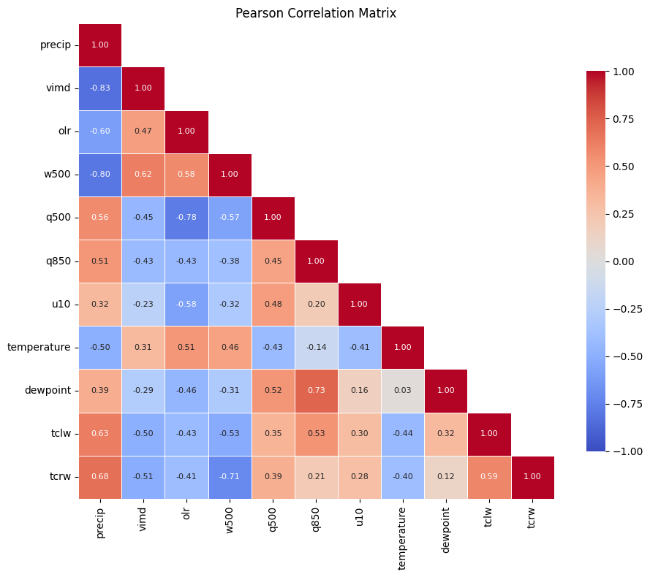
In this study, we developed and evaluated daily rainfall prediction models utilizing deep learning architectures, specifically comparing Long Short-Term Memory (LSTM) and Transformer models integrated with various atmospheric predictors. Our results indicate that the LSTM achieved superior accuracy at short-term lags—reaching an R² of 0.94 and an RMSE as low as 4.81 at lag-3—whereas the Transformer demonstrated higher consistency across all lags, maintaining stable R² values between 0.87 and 0.88. The application of a 5-day smoothing pre-processing step significantly enhanced prediction quality for both architectures by mitigating high-frequency noise, a benefit particularly pronounced in the LSTM due to its sensitivity to data fluctuations. Notably, the inclusion of tropical wave variables did not substantially improve model performance and, in some instances, reduced LSTM accuracy at longer lags by increasing input complexity; conversely, the Transformer remained robust to these additional variables. Among the predictors evaluated, Vertically Integrated Moisture Flux Divergence (VIMD) emerged as the most critical feature, underscoring its physical relevance to precipitation processes in convective and monsoonal regions. These findings suggest that while LSTMs excel at capturing immediate temporal dynamics, Transformers provide a more stable framework for longer-range rainfall forecasting in Jakarta.
Downloads
References
Ahmed, S., Nielsen, I. E., Tripathi, A., Siddiqui, S., Rasool, G., and Ramachandran, R. P. “Transformers in Time-series Analysis: A Tutorial,” International Journal of Electronics and Communications, Jul. 2023. doi: 10.1007/s00034-023-02454-8.
Aptula, A. O., Jeliazkova, N. G., Schultz, T. W., and Cronin, M. T. D. “The Better Predictive Model: High q2 for the Training Set or Low Root Mean Square Error of Prediction for the Test Set?,” QSAR Comb Sci, vol. 24, no. 3, pp. 385–396, 2005. doi: 10.1002/qsar.200430909.
Balles, L. and Hennig, P. “Dissecting Adam: The Sign, Magnitude and Variance of Stochastic Gradients,” 2020. doi: 10.48550/arXiv.1705.07774.
Chen, S., Adjei, C. O., Tian, W., Onzo, B.-M., Kedjanyi, E. A. G., and Darteh, O. F. “Rainfall Forecasting in Sub-Sahara Africa Ghana using LSTM Deep Learning Approach,” International Journal of Engineering Research & Technology, vol. 10, no. 3, 2021.
Chen, Y. et al. “Impacts of moisture transport on Extreme Precipitation in the Central Plains Urban Agglomeration, China,” Glob Planet Change, vol. 242, Nov. 2024. doi: 10.1016/j.gloplacha.2024.104582.
Cuo, L., Pagano, T. C., and Wang, Q. J. “A review of quantitative precipitation forecasts and their use in short- to medium-range streamflow forecasting,” J Hydrometeorol, vol. 12, no. 5, pp. 713–728, Oct. 2011. doi: 10.1175/2011JHM1347.1.
Dosovitskiy, A. et al. “An Image is Worth 16x16 Words: Transformers for Image Recognition at Scale,” Jun. 2021. [Online]. Available: http://arxiv.org/abs/2010.11929.
Hammouri, H. M., Sabo, R. T., Alsaadawi, R., and Kheirallah, K. A. “Handling skewed data: A comparison of two popular methods,” Applied Sciences (Switzerland), vol. 10, no. 18, Sep. 2020. doi: 10.3390/APP10186247.
Handayani, A. S., Permana, T., and Isoda, Y. “Role of updraft in dry-season torrential rainfall in Greater Jakarta, Indonesia,” Atmospheric Science Letters, vol. 24, no. 12, Dec. 2023. doi: 10.1002/asl.1186.
Hassan, E., Shams, M. Y., Hikal, N. A., and Elmougy, S. “The effect of choosing optimizer algorithms to improve computer vision tasks: a comparative study,” Multimed Tools Appl, vol. 82, no. 11, pp. 16591–16633, May 2023. doi: 10.1007/s11042-022-13820-0.
Hendra, Y., Mukhtar, H., Baidarus, and Hafsari, R. “Prediksi Curah Hujan di Kota Pekanbaru Menggunakan LSTM (Long Short Term Memory),” Software Engineering and Information System, vol. 3, no. 2, pp. 74–81, 2023.
Holloway, C. E. and Neelin, J. D. “Temporal Relations of Column Water Vapor and Tropical Precipitation,” J Atmos Sci, vol. 67, no. 4, pp. 1091–1105, Apr. 2010. doi: 10.1175/2009JAS3284.1.
Houze, R. A., Chen, S. S., Kingsmill, D. E., Serra, Y., and Yuter, S. E. “Convection over the Pacific Warm Pool in relation to the Atmospheric Kelvin-Rossby Wave,” J Atmos Sci, vol. 57, 2000.
Kamat, D. K. et al. “Investigation of atmospheric clouds and boundary layer Dynamics during a Dust Storm in the Western-Indian Region,” Remote Sens Appl, 2024. doi: 10.1016/j.rsase.2024.101442.
Lubis, S. W. and Jacobi, C. “The Modulating Influence of Convectively Coupled Equatorial Waves (CCEWs) on the Variability of Tropical Precipitation,” International Journal of Climatology, vol. 35, no. 7, pp. 1465–1483, Jun. 2015. doi: 10.1002/joc.4069.
Lubis, S. W. and Respati, M. R. “Impacts of convectively coupled equatorial waves on rainfall extremes in Java, Indonesia,” International Journal of Climatology, vol. 41, no. 4, pp. 2418–2440, Mar. 2021. doi: 10.1002/joc.6967.
Lu, Z., Ding, X., Yan, Q., and Guo, J. “Regional Forecast of Heavy Precipitation and Interpretability Based on TD-VAE,” in 40th Chinese Control Conference (CCC), 2021. doi: 10.23919/CCC52363.2021.9549531.
Mandasari, S., Irfan, D., Wanayumini, and Rosnelly, R. “Comparison of SGD, Adadelta, Adam Optimization in Gender Classification using CNN,” Teknologi dan Sistem Informasi, vol. 9, no. 3, Jun. 2023.
Muhammad, F. R. and Lubis, S. W. “Impacts of the Boreal Summer Intraseasonal Oscillation (BSISO) on Precipitation Extremes in Indonesia,” International Journal of Climatology, Mar. 2023. doi: 10.1002/essoar.10511986.1.
Muhammad, F. R., Lubis, S. W., and Setiawan, S. “Impacts of the Madden–Julian oscillation on precipitation extremes in Indonesia,” International Journal of Climatology, vol. 41, no. 3, pp. 1970–1984, Mar. 2021. doi: 10.1002/joc.6941.
Nayak, G. H. H. et al. “Modelling monthly rainfall of India through transformer-based deep learning architecture,” Model Earth Syst Environ, vol. 10, no. 3, pp. 1–18, 2024. doi: 10.1007/s40808-023-01944-7.
Olah, C. “Understanding LSTM Networks,” Github Blog, 2015.
Ouma, Y. O., Cheruyot, R., and Wachera, A. N. “Rainfall and runoff time-series trend analysis using LSTM recurrent neural network and wavelet neural network with satellite-based meteorological data: case study of Nzoia hydrologic basin,” Complex and Intelligent Systems, vol. 8, no. 1, pp. 213–236, Feb. 2022. doi: 10.1007/s40747-021-00365-2.
Pujol, K. et al. “Improving prediction of heavy rainfall in the Mediterranean with Neural Networks using both observation and Numerical Weather Prediction data,” Mar. 2025. [Online]. Available: http://arxiv.org/abs/2503.24216.
Staudemeyer, R. C. and Morris, E. R. “Understanding LSTM -- a Tutorial Into Long Short-Term Memory Recurrent Neural Networks,” arXiv preprint, Sep. 2019. Available: http://arxiv.org/abs/1909.09586.
Shrestha, D. L., Robertson, D. E., Wang, Q. J., Pagano, T. C., and Hapuarachchi, H. A. P. “Evaluation of numerical weather prediction model precipitation forecasts for short-term streamflow forecasting purpose,” Hydrol Earth Syst Sci, vol. 17, no. 5, pp. 1913–1931, 2013. doi: 10.5194/hess-17-1913-2013.
Sumargo, B., Handayani, D., Lubis, A. P., Firmasyah, I., and Wulansari, I. Y. “Detection of Factors Affecting Rainfall Intensity in Jakarta,” Jurnal Ilmu Lingkungan, vol. 23, no. 1, pp. 133–140, Jan. 2025. doi: 10.14710/jil.23.1.133-140.
Trilaksono, N. J., Otsuka, S., and Yoden, S. “A Time-Lagged Ensemble Simulation on the Modulation of Precipitation over West Java in January–February 2007,” Mon Weather Rev, vol. 140, no. 2, pp. 601–616, Feb. 2012. doi: 10.1175/MWR-D-11-00094.1.
Vaswani, A. et al. “Attention Is All You Need,” Advances in Neural Information Processing Systems, 2023.
Wiranda, L. and M. Sadikin. “Penerapan Long Short Term Memory pada Data Time Series untuk Memprediksi Penjualan Produk PT. Metiska Farma,” Nasional Pendidikan Teknik Informatika: JANAPATI, vol. 8, no. 3, pp. 184–196, 2020. doi: 10.23887/janapati.v8i3.19139.
Yanai, M., Esbensen, S., and Chu, J.-H. “Determination of Bulk Properties of Tropical Cloud Clusters from Large-Scale Heat and Moisture Budgets,” J Atmos Sci, vol. 4, no. 67, pp. 611–627, May 1973.
Downloads
Published
How to Cite
Issue
Section
License
Copyright (c) 2026 Akhdan Fadhilah Yaskur Hardiano, Sonni Setiawan

This work is licensed under a Creative Commons Attribution-ShareAlike 4.0 International License.
Authors who publish with this journal agree to the following terms:
- Authors retain copyright and grant the journal right of first publication with the work simultaneously licensed under a Creative Commons Attribution License that allows others to share the work with an acknowledgement of the work's authorship and initial publication in this journal.
- Authors are able to enter into separate, additional contractual arrangements for the non-exclusive distribution of the journal's published version of the work (e.g., post it to an institutional repository or publish it in a book), with an acknowledgement of its initial publication in this journal.
- Authors are permitted and encouraged to post their work online (e.g., in institutional repositories or on their website) prior to and during the submission process, as it can lead to productive exchanges, as well as earlier and greater citation of published work.