Comparative Analysis of Weather Radar Signatures of Puting Beliung in Indonesia
DOI:
https://doi.org/10.31172/jmg.v26i2.1180Keywords:
puting beliung, tornadoes, weather radar, echoesAbstract
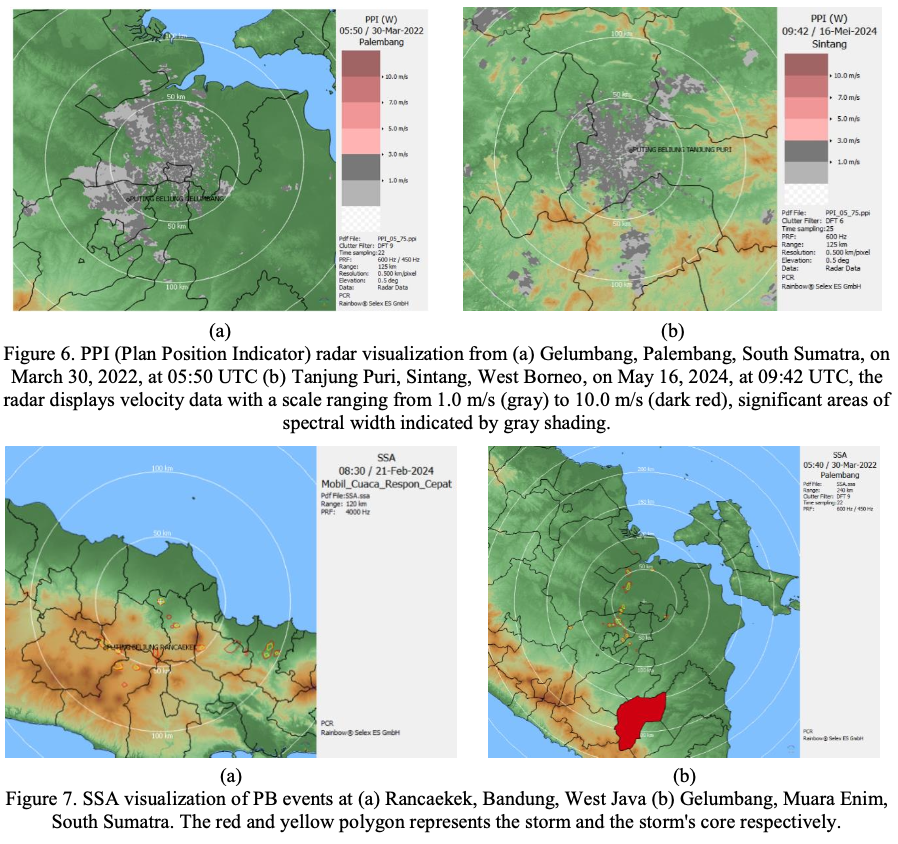
This study presents a comprehensive radar-based analysis of Puting Beliung (PB), Indonesia’s localized tornado phenomenon, using multiple weather radar–derived products. A comparative analysis of ten PB cases was conducted to identify consistent meteorological signatures and variations in tropical storm behavior, motivated by recent observations indicating an increasing frequency of PB events in Indonesia and the need for improved detection methods. Analysis using Rainbow software reveals consistently high reflectivity values ranging from 35 to 60 dBZ, with diverse echo patterns, among which the hook echo is the most dominant. Physical parameters show horizontal wind speeds of 10–30 knots at an altitude of 4 km, horizontal shear of 5–10 m s⁻¹ km⁻¹, and vertical shear of 1–10 m s⁻¹ km⁻¹, while spectral width analysis indicates moderate turbulence with values around 3 m s⁻¹. The Tornadic Vortex Detection (TVD) product identifies potential vortex signatures at six locations, with detected heights ranging from 1.2 to 3.1 km. This study represents the first comprehensive application of multiple radar products for PB characterization in Indonesia and identifies CMAX, HWIND, HSHEAR, and TVD as the most effective products for PB detection and monitoring. These findings provide essential baseline criteria for the development of radar-based early warning systems tailored to Indonesia’s tropical environment, with the potential to reduce the socioeconomic impacts of PB events through improved detection and prediction capabilities.
Downloads
References
BNPB, “Statistik Bencana Menurut Jenis,” 2024. [Online]. Available: https://dibi.bnpb.go.id/kbencana2
BMKG, “Prosedur Standar Operasi Pelaksanaan Peringatan Dini Pelaporan dan Diseminasi Informasi Cuaca Ekstrim,” p. 3, 2010.
S. Lee, J. Kim, Y. Maharani, E. Paripurno, and Sunaryo, “Analysis of the Risk of Windstorm (Angin Puting Beliung) in Indonesia,” Journal of Wind Engineering Institute of Korea, vol. 2, no. 1, pp. 21–28, 2017.
S. Mujiasih, S. T. Primadi, J. R. Tuban, and K. Badung, “Analisis Kejadian Puting Beliung Tanggal 11 Desember 2013 di Wilayah Denpasar Bagian Selatan,” Prosiding Workshop Radar dan Satelit Cuaca, vol. II, pp. 117–122, 2014.
E. Yulihastin, “A High Wind Associated with Bow Echo Mesovortex over Cimenyan, Indonesia,” Research Square, pp. 1–24, 2023. [Online]. Available: https://assets-eu.researchsquare.com/files/rs-3424786/v1/f6605e16-c931-48c5-95ea-93d0e1737963.pdf
E. Nurjani, A. Rahayu, and F. Rachmawati, “Kajian Bencana Angin Ribut di Indonesia Periode 1990–2011: Upaya Mitigasi Bencana,” Geomedia: Majalah Ilmiah dan Informasi Kegeografian, vol. 11, no. 2, pp. 191–206, 2013, doi: 10.21831/gm.v11i2.3451.
R. Darman, “Analisis Data Kejadian Bencana Angin Puting Beliung dengan Metode Online Analytical Processing (OLAP),” SINTECH (Science Information Technology Journal), vol. 2, no. 1, pp. 18–23, 2019, doi: 10.31598/sintechjournal.v2i1.298.
A. Ali and S. Hidayati, “Whirl Wind Detection and Identification in Indonesia Utilizing Single Polarization Doppler Weather Radar Volumetric Data,” International Archives of the Photogrammetry, Remote Sensing and Spatial Information Sciences, vol. 41, pp. 1221–1227, 2016, doi: 10.5194/isprsarchives-XLI-B8-1221-2016.
T. Nurlambang et al., “Penanggulangan Bencana Cuaca Ekstrim di Indonesia,” Prosiding Seminar Nasional Riset Kebencanaan, pp. 1–8, 2013.
K. Kiki, Y. Koesmaryono, R. Hidayat, D. S. Permana, and P. Perdinan, “Spatiotemporal Characteristics and Trend of Puting Beliung across the Indonesian Archipelago,” Indonesian Journal of Geography, vol. 57, pp. 334–346, 2025, doi: 10.22146/ijg.103901.
T. Aliftha, A. Azwar, and R. Adriat, “Penerapan Metode Analisis Diskriminan terhadap Variasi Unsur Cuaca pada Kejadian Puting Beliung di Jawa Tengah,” Prisma Fisika, vol. 8, no. 1, pp. 57–61, 2020, doi: 10.26418/pf.v8i1.40174.
G. R. Nikmah and H. Hazim, “Gambaran Kecemasan Masyarakat Desa X di Sidoarjo Pasca Bencana Angin Puting Beliung,” Jurnal Mahasiswa BK An-Nur: Berbeda, Bermakna, Mulia, vol. 9, no. 3, pp. 150–156, 2023, doi: 10.31602/jmbkan.v9i3.12054.
E. De Lima Nascimento, G. Held, and A. M. Gomes, “A Multiple-Vortex Tornado in Southeastern Brazil,” Monthly Weather Review, vol. 142, no. 9, pp. 3017–3037, 2014, doi: 10.1175/MWR-D-13-00319.1.
M. S. Veillette et al., “A Benchmark Dataset for Tornado Detection and Prediction Using Full-Resolution Polarimetric Weather Radar Data,” pp. 1–37, 2024. [Online]. Available: http://arxiv.org/abs/2401.16437
Q. Zeng et al., “Application of Random Forest Algorithm on Tornado Detection,” Remote Sensing, vol. 14, no. 19, pp. 1–22, 2022, doi: 10.3390/rs14194909.
Leonardo Germany GmbH, “Software Manual Rainbow® 5 Products & Algorithms Guide,” 2023. [Online]. Available: https://www.leonardogermany.com
I. Rusmala et al., “Identification of Small Tornado Event Using Weather Radar and Himawari-8 Products (Case Study: Puting Beliung Event on November 22, 2018 in Jakarta),” Proceedings of the 2nd International Conference on Tropical Meteorology and Atmospheric Science, pp. 15–20, 2022.
I. J. A. Saragih et al., “Utilization of Red-Green-Blue (RGB) Modification Composite for Nighttime Convective Cloud Monitoring over North Sumatra Region,” IOP Conference Series: Earth and Environmental Science, vol. 893, no. 1, 2021, doi: 10.1088/1755-1315/893/1/012019.
R. D. Yudistira et al., “Utilization of Surface Meteorological Data, Himawari-8 Satellite Data, and Radar Data to Analyze Landspout in Sumenep, East Java, Indonesia,” IOP Conference Series: Earth and Environmental Science, vol. 374, no. 1, 2019, doi: 10.1088/1755-1315/374/1/012038.
J. Xie et al., “Multi-Task Learning for Tornado Identification Using Doppler Radar Data,” Geophysical Research Letters, vol. 51, no. 11, 2024, doi: 10.1029/2024GL108809.
S. Cao et al., “Radar Characteristics and Causal Analysis of Two Consecutive Tornado Events Associated with Heavy Precipitation during the Mei-Yu Season,” Remote Sensing, vol. 15, no. 23, pp. 1–22, 2023, doi: 10.3390/rs15235470.
R. A. Brown and V. T. Wood, “Detection of the Presence of Tornadoes at the Center of Mesocyclones Using Simulated Doppler Velocity Measurements,” Weather and Forecasting, vol. 30, no. 4, pp. 957–963, 2015, doi: 10.1175/WAF-D-15-0014.1.
J. L. Houser et al., “Additional Evaluation of the Spatiotemporal Evolution of Rotation during Tornadogenesis Using Rapid-Scan Mobile Radar Observations,” Monthly Weather Review, vol. 150, no. 7, pp. 1639–1666, 2022, doi: 10.1175/MWR-D-21-0227.1.
Y. Wang et al., “A Numerical Simulation of the ‘1907’ Kaiyuan Tornado Weather Process in Liaoning, Northeast China,” Atmosphere, vol. 13, no. 2, 2022, doi: 10.3390/atmos13020219.
M. M. French et al., “Documenting a Rare Tornado Merger Observed in the 24 May 2011 El Reno–Piedmont, Oklahoma Supercell,” Monthly Weather Review, vol. 143, no. 8, pp. 3025–3043, 2015, doi: 10.1175/MWR-D-14-00349.1.
W. Mashiko, “A Numerical Study of the 6 May 2012 Tsukuba City Supercell Tornado. Part II: Mechanisms of Tornadogenesis,” Monthly Weather Review, vol. 144, no. 9, pp. 3077–3098, 2016, doi: 10.1175/MWR-D-15-0122.1.
F. Kobayashi et al., “Tornado Generation in a Narrow Cold Frontal Rainband: Fujisawa Tornado on April 20, 2006,” Scientific Online Letters on the Atmosphere, vol. 3, pp. 21–24, 2007, doi: 10.2151/sola.2007-006.
H. Y. Inoue et al., “Finescale Doppler Radar Observation of a Tornado and Low-Level Misocyclones within a Winter Storm in the Japan Sea Coastal Region,” Monthly Weather Review, vol. 139, no. 2, pp. 351–369, 2011, doi: 10.1175/2010MWR3247.1.
B. Wu, M. Wei, and Y. Li, “Dual-Polarization Radar Observations of the Evolution of a Supercell Tornado and Analysis of the Echo Mechanisms,” Atmosphere, vol. 13, no. 5, pp. 1–17, 2022, doi: 10.3390/atmos13050797.
Y. Li et al., “Comparative Analysis of Two Tornado Processes in Southern Jiangsu,” Atmosphere, vol. 15, 2024, doi: 10.3390/atmos15081010.
S. Lim et al., “Polarimetric Radar Signatures of a Rare Tornado Event over South Korea,” Journal of Atmospheric and Oceanic Technology, vol. 35, no. 10, pp. 1977–1997, 2018, doi: 10.1175/JTECH-D-18-0041.1.
F. Vanessa, G. Vitor, and N. Ernani de Lima, “An Environmental and Polarimetric Study of the 19 November 2015 Supercell and Multiple-Vortex Tornado in Southern Brazil,” Meteorology and Atmospheric Physics, vol. 134, p. 82, 2022.
M. K. Das et al., “Simulation of Tornado over Brahmanbaria on 22 March 2013 Using Doppler Weather Radar and WRF Model,” Geomatics, Natural Hazards and Risk, vol. 7, no. 5, pp. 1577–1599, 2016, doi: 10.1080/19475705.2015.1115432.
L. E. Lekoloane et al., “A Dynamic and Thermodynamic Analysis of the 11 December 2017 Tornadic Supercell in the Highveld of South Africa,” Weather and Climate Dynamics, vol. 2, no. 2, pp. 373–393, 2021, doi: 10.5194/wcd-2-373-2021.
J. S. Goodnight et al., “Quantification of QLCS Tornadogenesis, Associated Characteristics, and Environments across a Large Sample,” Weather and Forecasting, vol. 37, no. 11, pp. 2087–2105, 2022, doi: 10.1175/WAF-D-22-0016.1.
C. N. Satrio et al., “Multi-Radar Analysis of the 20 May 2013 Moore, Oklahoma Supercell through Tornadogenesis and Intensification,” Atmosphere, vol. 12, no. 3, pp. 1–30, 2021, doi: 10.3390/atmos12030313.
J. Wang et al., “Climatological Occurrences of Hail and Tornadoes Associated with Mesoscale Convective Systems in the United States,” Natural Hazards and Earth System Sciences, vol. 23, no. 12, pp. 3823–3838, 2023, doi: 10.5194/nhess-23-3823-2023.
D. Yao et al., “Genesis, Maintenance and Demise of a Simulated Tornado and the Evolution of Its Preceding Descending Reflectivity Core (DRC),” Atmosphere, vol. 10, no. 5, 2019, doi: 10.3390/atmos10050236.
C. B. Griffin et al., “High-Temporal Resolution Observations of the 27 May 2015 Canadian, Texas Tornado Using the Atmospheric Imaging Radar,” Monthly Weather Review, vol. 147, no. 3, pp. 873–891, 2019, doi: 10.1175/MWR-D-18-0297.1.
M. M. French et al., “Reexamining the Vertical Development of Tornadic Vortex Signatures in Supercells,” Monthly Weather Review, vol. 141, no. 12, pp. 4576–4601, 2013, doi: 10.1175/MWR-D-12-00315.1.
R. Lagerquist et al., “Deep Learning on Three-Dimensional Multiscale Data for Next-Hour Tornado Prediction,” Monthly Weather Review, vol. 148, no. 7, pp. 2837–2861, 2020, doi: 10.1175/MWR-D-19-0372.1.
V. A. Gensini et al., “Machine Learning Classification of Significant Tornadoes and Hail in the United States Using ERA5 Proximity Soundings,” Weather and Forecasting, vol. 36, no. 6, pp. 2143–2160, 2021, doi: 10.1175/WAF-D-21-0056.1.
Downloads
Published
How to Cite
Issue
Section
License
Copyright (c) 2026 Kiki, Yonny Koesmaryono, Rahmat Hidayat, Donaldi Sukma Permana, Perdinan

This work is licensed under a Creative Commons Attribution-ShareAlike 4.0 International License.
Authors who publish with this journal agree to the following terms:
- Authors retain copyright and grant the journal right of first publication with the work simultaneously licensed under a Creative Commons Attribution License that allows others to share the work with an acknowledgement of the work's authorship and initial publication in this journal.
- Authors are able to enter into separate, additional contractual arrangements for the non-exclusive distribution of the journal's published version of the work (e.g., post it to an institutional repository or publish it in a book), with an acknowledgement of its initial publication in this journal.
- Authors are permitted and encouraged to post their work online (e.g., in institutional repositories or on their website) prior to and during the submission process, as it can lead to productive exchanges, as well as earlier and greater citation of published work.