Determining Monsoon Onset Dates in Makassar Using Rainfall Anomalies and Moisture Source Trajectory Analysis (1991–2020)
DOI:
https://doi.org/10.31172/jmg.v26i2.1162Keywords:
Rainfall anomalies, Moisture transport, Climate variability, Backward trajectory analysisAbstract
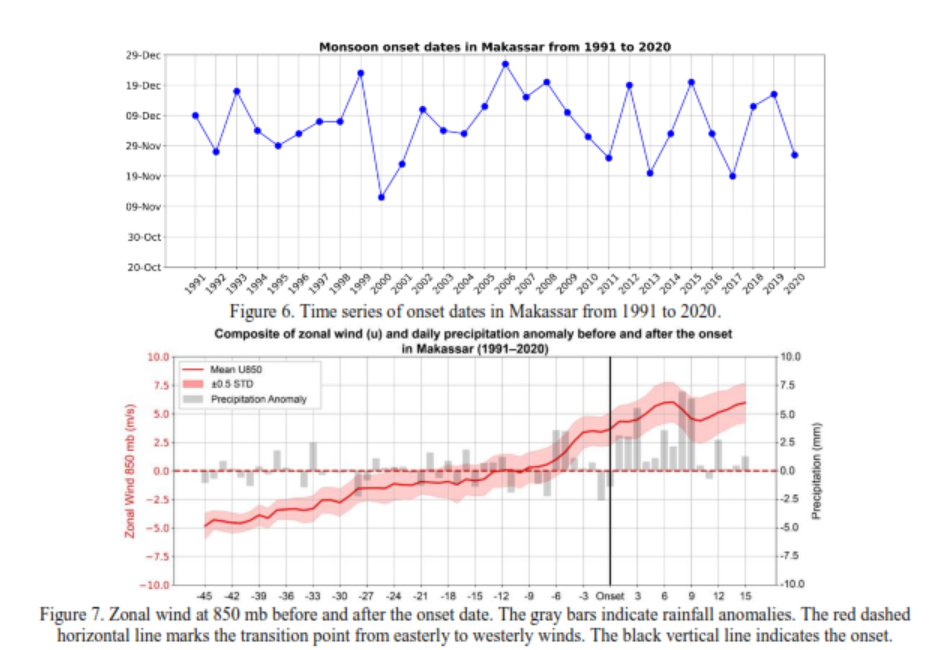
Makassar exhibits a typical monsoonal rainfall regime, characterized by a strong annual cycle with peak rainfall occurring in January–February. Understanding the onset of the rainy season in this region is crucial for water resource management and disaster preparedness, yet previous studies have generally relied only on rainfall-based criteria with coarse temporal resolution. This study aims to determine the onset date of the rainy season in Makassar by combining local rainfall anomalies with regional-scale moisture-source trajectories. Daily rainfall data for 1991–2020 were analyzed using harmonic reconstruction to identify the climatological peak of the monsoon season, which then guided the moisture trajectory analysis. The results show that most rainy-season onsets occur in November–December, with high interannual variability influenced by large-scale climate drivers such as ENSO. Moisture transport during the peak rainy months is predominantly derived from the Northern Maritime (58.8%) and Tropical Maritime (40.5%) sources, highlighting the essential role of cross-equatorial water-vapor advection. In addition, changes in zonal wind direction at 850 hPa consistently coincide with the onset, providing an independent dynamical indicator of the transition from dry to wet phase. By explicitly linking rainfall anomalies with the timing of dynamical shifts and dominant moisture pathways, this approach reduces ambiguities commonly found in rainfall-only methods and produces onset estimates that align more closely with regional atmospheric dynamics. Compared to previous rainfall-only approaches, this combined local–regional method provides a more representative onset estimate at daily resolution, offering new insight into the mechanisms of monsoon rainfall in coastal areas of eastern Indonesia.
Downloads
References
Zhang, S., & Wang, B. (2008). Global summer monsoon rainy seasons. International Journal of Climatology: A Journal of the Royal Meteorological Society, 28(12), 1563–1578.
Muttaqin, A. S. (2023). Land-Atmosphere Interactions over the Indonesian Maritime Continent. The University of Wisconsin–Madison.
Yang, D., Yang, Y., & Xia, J. (2021). Hydrological cycle and water resources in a changing world: A review. Geography and Sustainability, 2(2), 115–122.
Ahmed, M., Hayat, R., Ahmad, M., Ul-Hassan, M., Kheir, A. M., Ul-Hassan, F., & Ahmad, S. (2022). Impact of climate change on dryland agricultural systems: A review of current status, potentials, and further work need. International Journal of Plant Production, 16(3), 341–363.
Oyebode, O. J., Oyerinde, A. O., & Oyebode, F. A. (2023). Engineering hydrology for flood control, adequate water resources and sustainable environment in Nigeria. Journal of Water Resource Engineering and Management, 10(2), 1–10.
Ulfiana, A., Arsyad, M., & Palloan, P. (2023). The atmospheric dynamics related to extreme rainfall and flood events during September–October–November in South Sulawesi. Forum Geografi, 37(2), 107–116.
Wainwright, C. M., Black, E., & Allan, R. P. (2021). Future changes in wet and dry season characteristics in CMIP5 and CMIP6 simulations. Journal of Hydrometeorology, 22(9), 2339–2357.
Ren, W., Tian, L., & Shao, L. (2021). Regional moisture sources and Indian summer monsoon (ISM) moisture transport from simultaneous monitoring of precipitation isotopes on the southeastern and northeastern Tibetan Plateau. Journal of Hydrology, 601, 126836.
Ferijal, T., Batelaan, O., Shanafield, M., & Alfahmi, F. (2022). Determination of rainy season onset and cessation based on a flexible driest period. Theoretical and Applied Climatology, 148(1), 91–104.
Moron, V., Robertson, A. W., & Boer, R. (2009). Spatial coherence and seasonal predictability of monsoon onset over Indonesia. Journal of Climate, 22(3), 840–850.
Wilks, D. S. (2011). Statistical methods in the atmospheric sciences (Vol. 100). Academic Press.
Serrano-Vincenti, S., Condom, T., Campozano, L., Escobar, L. A., Walpersdorf, A., Carchipulla-Morales, D., & Villacís, M. (2022). Harmonic analysis of the relationship between GNSS precipitable water vapor and heavy rainfall over the Northwest Equatorial Coast, Andes, and Amazon Regions. Atmosphere, 13(11), 1809.
Schlegel, R. W., Oliver, E. C., & Chen, K. (2021). Drivers of marine heatwaves in the Northwest Atlantic: The role of air–sea interaction during onset and decline. Frontiers in Marine Science, 8, 627970.
Guo, X., Wang, L., Tian, L., Zhang, L., & Zhao, W. (2025). Quantitative identification of moisture sources over the Tibetan Plateau: Spatial distributions and temporal variabilities. Journal of Climate, 38(1), 263–276.
Hu, Y., Stamnes, K., Vaughan, M., Pelon, J., Weimer, C., Wu, D., Cisewski, M., Sun, W., Yang, P., Lin, B., & Omar, A. (2008). Sea surface wind speed estimation from space-based lidar measurements. Atmospheric Chemistry and Physics, 8(13), 3593–3601.
Gimeno, L., Stohl, A., Trigo, R. M., Dominguez, F., Yoshimura, K., Yu, L., & Nieto, R. (2012). Oceanic and terrestrial sources of continental precipitation. Reviews of Geophysics, 50(4).
James, P., Stohl, A., Spichtinger, N., Eckhardt, S., & Forster, C. (2004). Climatological aspects of the extreme European rainfall of August 2002 and a trajectory method for estimating the associated evaporative source regions. Natural Hazards and Earth System Sciences, 4, 733–746.
Rahmah, A., & Baeda, A. Y. (2024). Pengaruh Madden–Julian Oscillation terhadap variabilitas suhu permukaan laut di Selat Makassar. Riset Sains dan Teknologi Kelautan, 129–133.
Cheng, T. F., Lu, M., & Dai, L. (2021). Moisture channels and pre-existing weather systems for East Asian rain belts. NPJ Climate and Atmospheric Science, 4(1), 32.
Stohl, A., & James, P. (2004). A Lagrangian analysis of the atmospheric branch of the global water cycle. Part I: Method description, validation, and demonstration for the August 2002 flooding in Central Europe. Journal of Hydrometeorology, 5, 656–678.
Purwaningsih, A., Lubis, S. W., Hermawan, E., Andarini, D. F., Harjana, T., Ratri, D. N., ... & Sujalu, A. P. (2022). Moisture origin and transport for extreme precipitation over Indonesia’s new capital city, Nusantara in August 2021. Atmosphere, 13(9), 1391.
Khan, S., Piao, S., Zheng, G., Khan, I. U., Bradley, D., Khan, S., & Song, Y. (2021). Sea surface temperature variability over the tropical Indian Ocean during the ENSO and IOD events in 2016 and 2017. Atmosphere, 12(5), 587.
Bonazza, M. (2021). Water vapor, precipitation and evapotranspiration isotopic composition in the tropical atmospheric boundary layer (Doctoral dissertation, Georg-August Universität Göttingen).
Cai, W., Santoso, A., Collins, M., Dewitte, B., Karamperidou, C., Kug, J. S., & Zhong, W. (2021). Changing El Niño–Southern Oscillation in a warming climate. Nature Reviews Earth & Environment, 2(9), 628–644.
Li, X., Hu, Z. Z., Tseng, Y. H., Liu, Y., & Liang, P. (2022). A historical perspective of the La Niña event in 2020/2021. Journal of Geophysical Research: Atmospheres, 127(7), e2021JD035546.
Du, Y., Xie, Z., Wang, N., Miao, Q., & Zhang, L. (2022). Influence of zonal variation of the subtropical westerly jet on rainfall patterns and frequency of heavy precipitation events over East Asia. Journal of Climate, 35(20), 6611–6626.
Rosalina, D., Suryadi, L. P. F., Rombe, K. H., Leilani, A., Irwana, I., & Haris, R. B. K. (2024). Salinity distribution pattern in Spermonde waters using remote sensing data (Copernicus Marine Service) in 2022. Jurnal Kelautan: Indonesian Journal of Marine Science and Technology, 17(1), 43–54.
Huang, L., Chen, J., Yang, K., Yang, Y., Huang, W., Zhang, X., & Chen, F. (2023). The northern boundary of the Asian summer monsoon and division of westerlies and monsoon regimes over the Tibetan Plateau in present-day. Science China Earth Sciences, 66(4), 882–893.
Wang, Q., Wang, L., Huang, G., & Wang, T. (2023). Mechanism of the summer rainfall interannual variability in transitional climate zone in East Asia: Roles of teleconnection patterns and associated moisture processes. Climate Dynamics, 61(3), 1177–1192.
Downloads
Published
How to Cite
Issue
Section
License
Copyright (c) 2026 Rheinhart Hutauruk, Tri Wahyu Hadi, Robi Muharsyah, Selvy Yolanda

This work is licensed under a Creative Commons Attribution-ShareAlike 4.0 International License.
Authors who publish with this journal agree to the following terms:
- Authors retain copyright and grant the journal right of first publication with the work simultaneously licensed under a Creative Commons Attribution License that allows others to share the work with an acknowledgement of the work's authorship and initial publication in this journal.
- Authors are able to enter into separate, additional contractual arrangements for the non-exclusive distribution of the journal's published version of the work (e.g., post it to an institutional repository or publish it in a book), with an acknowledgement of its initial publication in this journal.
- Authors are permitted and encouraged to post their work online (e.g., in institutional repositories or on their website) prior to and during the submission process, as it can lead to productive exchanges, as well as earlier and greater citation of published work.