The Correlation Between Sea Surface Temperature Variability and Convective Cloud Characteristics over Ambon Island Coastal Waters
DOI:
https://doi.org/10.31172/jmg.v26i2.1085Keywords:
Sea Surface Temperature (SST), Convective Cloud Characteristics, Radiosonde Observations, Monsoonal Variability, Ambon Coastal WatersAbstract
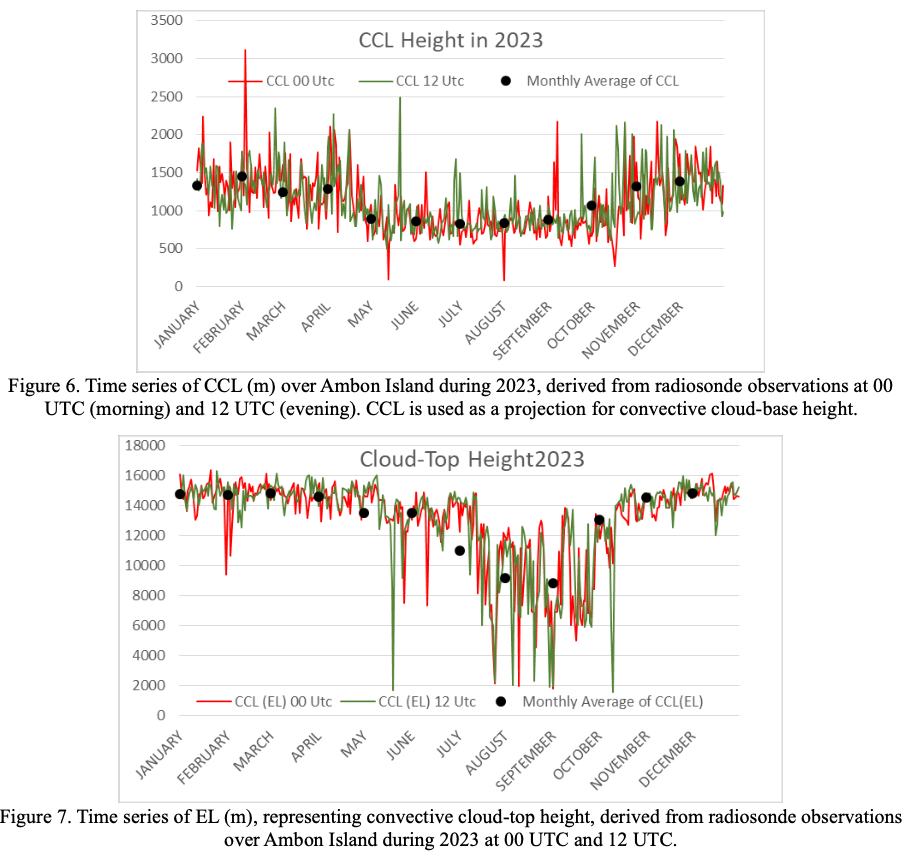
Sea surface temperature (SST) plays a key role in modulating tropical convection, yet its influence on the vertical structure of convective clouds in island-based, anti-monsoonal regions remains poorly quantified. This study examines the relationship between SST variability and convective cloud characteristics over the coastal waters of Ambon Island during 2023. Daily SST data were obtained from ERA5 reanalysis, while convective parameters Convective Condensation Level (CCL) and Equilibrium Level (EL) were derived from twice-daily radiosonde observations. Owing to non-normal distributions and serial autocorrelation, Spearman rank correlation was applied with effective sample size (ESS) correction and bootstrap confidence intervals. Results show that SST exhibits a pronounced seasonal cycle primarily governed by monsoonal forcing. SST displays a moderate positive correlation with CCL (ρ = 0.532-0.580) and a consistently strong correlation with EL across all stations (ρ = 0.770-0.778; p_adj < 0.001), indicating a stronger SST control on convective depth than on cloud-base height. Although large-scale climate modes (ENSO, IOD, and MJO) contribute to short-term variability, seasonal monsoonal forcing remains the dominant modulator of SST-convection coupling. These findings represent robust statistical associations and highlight the importance of ocean-atmosphere coupling in regulating convective cloud structure in tropical maritime island environments.
Downloads
References
C. S. Ramage, “Role of a Tropical ‘Maritime Continent’ in the Atmospheric Circulation 1,” Monthly Weather Review, Vol. 96, No. 6, pp. 365–370, Jun. 1968, doi: 10.1175/1520-0493(1968)096<0365:ROATMC>2.0.CO;2.
L. E. Back and C. S. Bretherton, “A Simple Model of Climatological Rainfall and Vertical Motion Patterns over the Tropical Oceans,” Journal of Climate, Vol. 22, No. 23, pp. 6477–6497, Dec. 2009, doi: 10.1175/2009JCLI2393.1.
A. H. Sobel and C. S. Bretherton, “Modeling Tropical Precipitation in a Single Column,” Journal of Climate, Vol. 13, No. 24, pp. 4378–4392, Dec. 2000, doi: 10.1175/1520-0442(2000)013<4378:MTPIAS>2.0.CO;2.
S. Lorian and G. Dagan, “On the Sensitivity of Aerosol-Cloud Interactions to Changes in Sea Surface Temperature in Radiative-Convective Equilibrium,” EGUsphere, Vol. 2023, pp. 1–20, 2023, doi: 10.5194/egusphere-2023-2096.
A. M. Tompkins, “On the Relationship Between Tropical Convection and Sea Surface Temperature,” Journal of Climate, Vol. 14, No. 5, pp. 633–637, Mar. 2001, doi: 10.1175/1520-0442(2001)014<0633:OTRBTC>2.0.CO;2.
E. Aldrian and R. Dwi Susanto, “Identification of Three Dominant Rainfall Regions within Indonesia and Their Relationship to Sea Surface Temperature,” International Journal of Climatology, Vol. 23, No. 12, pp. 1435–1452, Oct. 2003, doi: 10.1002/joc.950.
C. Corvianawatie, M. R. Putri, S. Y. Cahyarini, and W. M. Tatipatta, “Variabilitas Suhu Permukaan Laut dan Salinitas Permukaan Laut di Teluk Ambon dan Kaitannya dengan ENSO/IOD dan Monsun,” Geospasial Indonesia, Vol. 3, No. 2, Dec. 2014. Accessed: Jul. 26, 2025. [Online]. Available: https://journals.itb.ac.id/index.php/ijog/article/view/2147
G. Tristianto, S. Y. Wulandari, A. A. D. Suryoputro, G. Handoyo, and M. Zainuri, “Studi Variabilitas Upwelling di Laut Banda,” Indonesian Journal of Oceanography, Vol. 3, No. 1, pp. 25–35, Mar. 2021, doi: 10.14710/ijoce.v3i1.9764.
A. Y. Baeda, C. Pao’tonan, and D. Abdullah, “The Correlation Between Sea Surface Temperature and MJO Incidence in Indonesian Waters,” IOP Conference Series: Earth and Environmental Science, Vol. 235, p. 012020, Feb. 2019, doi: 10.1088/1755-1315/235/1/012020.
U. O. Nurafifah, M. Zainuri, and A. Wirasatriya, “Pengaruh ENSO dan IOD terhadap Distribusi Suhu Permukaan Laut dan Klorofil-a pada Periode Upwelling di Laut Banda,” Indonesian Journal of Oceanography, Vol. 4, No. 3, pp. 74–85, Aug. 2022, doi: 10.14710/ijoce.v4i3.14971.
M. D. Syaifullah, “Analisis Kondisi Udara Atas Wilayah Indonesia dengan Data Radiosonde,” Jurnal Meteorologi dan Geofisika, Vol. 18, No. 1, Mar. 2018, doi: 10.31172/jmg.v18i1.268.
D. J. Seidel, R. J. Ross, J. K. Angell, and G. C. Reid, “Climatological Characteristics of the Tropical Tropopause as Revealed by Radiosondes,” Journal of Geophysical Research: Atmospheres, Vol. 106, No. D8, pp. 7857–7878, Apr. 2001, doi: 10.1029/2000JD900837.
Y. S. Swarinoto and E. E. S. Makmur, “Simulasi Prediksi Probabilitas Awal Musim Hujan dan Panjang Musim Hujan di ZOM 126 Denpasar,” Jurnal Meteorologi dan Geofisika, Vol. 11, No. 1, Jun. 2010, doi: 10.31172/jmg.v11i1.56.
H. Hersbach et al., “The ERA5 Global Reanalysis,” Quarterly Journal of the Royal Meteorological Society, Vol. 146, No. 730, pp. 1999–2049, Jul. 2020, doi: 10.1002/qj.3803.
H. Hersbach et al., “Copernicus Climate Change Service,” Climate Data Store. Accessed: Dec. 21, 2025. [Online]. Available: https://cds.climate.copernicus.eu/datasets/reanalysis-era5-single-levels
J. R. Holton and G. J. Hakim, An Introduction to Dynamic Meteorology. Elsevier, 2013, doi: 10.1016/C2009-0-63394-8.
H.-Y. Ma et al., “A Multi-Year Short-Range Hindcast Experiment with CESM1 for Evaluating Climate Model Moist Processes from Diurnal to Interannual Timescales,” Geoscientific Model Development, Vol. 14, No. 1, pp. 73–90, Jan. 2021, doi: 10.5194/gmd-14-73-2021.
D. S. Wilks, Statistical Methods in the Atmospheric Sciences, 2nd ed., 2006. Accessed: Aug. 13, 2025. [Online]. Available: https://sunandclimate.wordpress.com/wp-content/uploads/2009/05/statistical-methods-in-the-atmospheric-sciences-0127519661.pdf
D. S. Wilks, “Indices of Rank Histogram Flatness and Their Sampling Properties,” Monthly Weather Review, Vol. 147, No. 2, pp. 763–769, Feb. 2019, doi: 10.1175/MWR-D-18-0369.1.
T. Dzikiro, M. Azka, B. Ananta, and A. Fadlan, Pemetaan Daerah Potensial Budidaya Tiram Mutiara Menggunakan Penginderaan Jauh Berdasarkan Parameter Kedalaman Perairan, Suhu Permukaan Laut, Arus Laut dan Kepadatan Fitoplankton terhadap Pola Musiman di Perairan Ambon, Maluku, 2018. Accessed: Jul. 26, 2025. [Online]. Available: https://www.researchgate.net/publication/351853331
S. Tubalawony, J. W. Tuahatu, and D. E. Kalay, “Water Quality of Haruku Strait Central Maluku Indonesia,” IOP Conference Series: Earth and Environmental Science, Vol. 1207, No. 1, 2023, doi: 10.1088/1755-1315/1207/1/012025.
B. Prasetyo, N. Pusparini, and I. Radjawane, “Profil Vertikal Suhu Laut Banda Terkait Kejadian El Niño di Pasifik Timur dan Pasifik Tengah,” Oseanologi dan Limnologi di Indonesia, Vol. 4, Feb. 2019, doi: 10.14203/oldi.2019.v4i1.171.
Y. Y. D. Pamungkas, D. D. P. Matruty, and S. Tubalawony, “Analisis Dinamika Daerah Penangkapan Ikan Berdasarkan Musim di Laut Seram,” Jurnal Inovasi Penelitian, Vol. 2, No. 7, pp. 2095–2100, Jul. 2021, doi: 10.47492/jip.v2i7.1055.
F. R. T. Saputra and Y. D. Lekalette, “Water Mass Dynamics in Ambon Bay,” Widyariset, Vol. 2, No. 2, p. 143, Nov. 2016, doi: 10.14203/widyariset.2.2.2016.143-152.
P. A. Kholiviana, Y. Ruhiat, and A. Saefullah, “Analisis Vertical Wind Shear pada Pertumbuhan Awan Cumulonimbus di Wilayah Kabupaten Tangerang,” Newton-Maxwell Journal of Physics, Vol. 3, No. 1, pp. 17–23, May 2022, doi: 10.33369/nmj.v3i1.21080.
R. A. Houze, “Mesoscale Convective Systems,” Reviews of Geophysics, Vol. 42, No. 4, Dec. 2004, doi: 10.1029/2004RG000150.
U. Fadika, A. Rifai, and B. Rochaddi, “Arah dan Kecepatan Angin Musiman serta Kaitannya dengan Sebaran Suhu Permukaan Laut di Selatan Pangandaran Jawa Barat,” Journal of Oceanography, Vol. 3, No. 3, pp. 429–437, Aug. 2014.
K. A. Emanuel, “Slantwise Convection,” in Atmospheric Convection, Oxford University Press, New York, 1994, pp. 392–417, doi: 10.1093/oso/9780195066302.003.0012.
S. H. Derbyshire et al., “Sensitivity of Moist Convection to Environmental Humidity,” Quarterly Journal of the Royal Meteorological Society, Vol. 130, No. 604, pp. 3055–3079, Oct. 2004, doi: 10.1256/qj.03.130.
Y. Zhang and S. A. Klein, “Mechanisms Affecting the Transition from Shallow to Deep Convection over Land: Inferences from Observations of the Diurnal Cycle Collected at the ARM Southern Great Plains Site,” Journal of the Atmospheric Sciences, Vol. 67, No. 9, pp. 2943–2959, Sep. 2010, doi: 10.1175/2010JAS3366.1.
J. D. Neelin, O. Peters, and K. Hales, “The Transition to Strong Convection,” Journal of the Atmospheric Sciences, Vol. 66, No. 8, pp. 2367–2384, Aug. 2009, doi: 10.1175/2009JAS2962.1.
Downloads
Published
How to Cite
Issue
Section
License
Copyright (c) 2024 Puput Mustika Pasaribu

This work is licensed under a Creative Commons Attribution-ShareAlike 4.0 International License.
Authors who publish with this journal agree to the following terms:
- Authors retain copyright and grant the journal right of first publication with the work simultaneously licensed under a Creative Commons Attribution License that allows others to share the work with an acknowledgement of the work's authorship and initial publication in this journal.
- Authors are able to enter into separate, additional contractual arrangements for the non-exclusive distribution of the journal's published version of the work (e.g., post it to an institutional repository or publish it in a book), with an acknowledgement of its initial publication in this journal.
- Authors are permitted and encouraged to post their work online (e.g., in institutional repositories or on their website) prior to and during the submission process, as it can lead to productive exchanges, as well as earlier and greater citation of published work.